

We have all been there. You roll up to the check-in counter, the agent lifts your bag onto the scale, and a number flashes that is two pounds over the limit. Suddenly you are unzipping on the floor of a busy airport, trying to stuff a pair of shoes into your carry-on while people shuffle past. The fee itself, usually $75 to $100 depending on the airline, stings. But the embarrassment and delay sting more. The good news is that this situation is almost entirely avoidable, and avoiding it costs less than a single overweight charge.
After years of traveling, mostly for school breaks and summer trips that involved more luggage than we care to admit, we landed on a five-step system that keeps bags under the limit every time. The centerpiece of that system is a small digital luggage scale we now pack on every trip without thinking twice. If you follow the steps below, you will not pay an overweight baggage fee again.
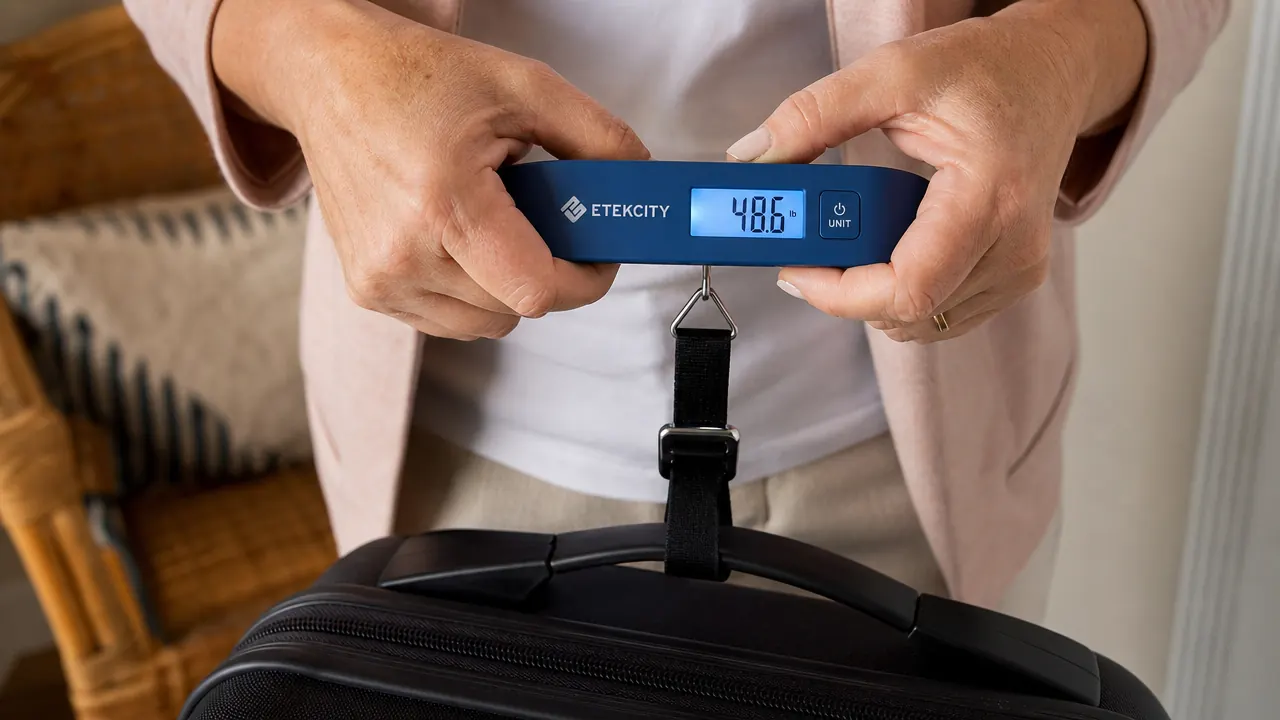
Stop guessing at the counter. The Etekcity luggage scale weighs your bag before you leave the house.
With over 70,000 reviews and a 4.7-star rating, it is the most trusted luggage scale on Amazon. It reads up to 110 pounds in one second, fits in a jacket pocket, and runs on two AAA batteries that last for years.
Amazon Check Today's Price on Amazon →Step 1: Know Your Airline's Actual Limit Before You Pack a Single Item
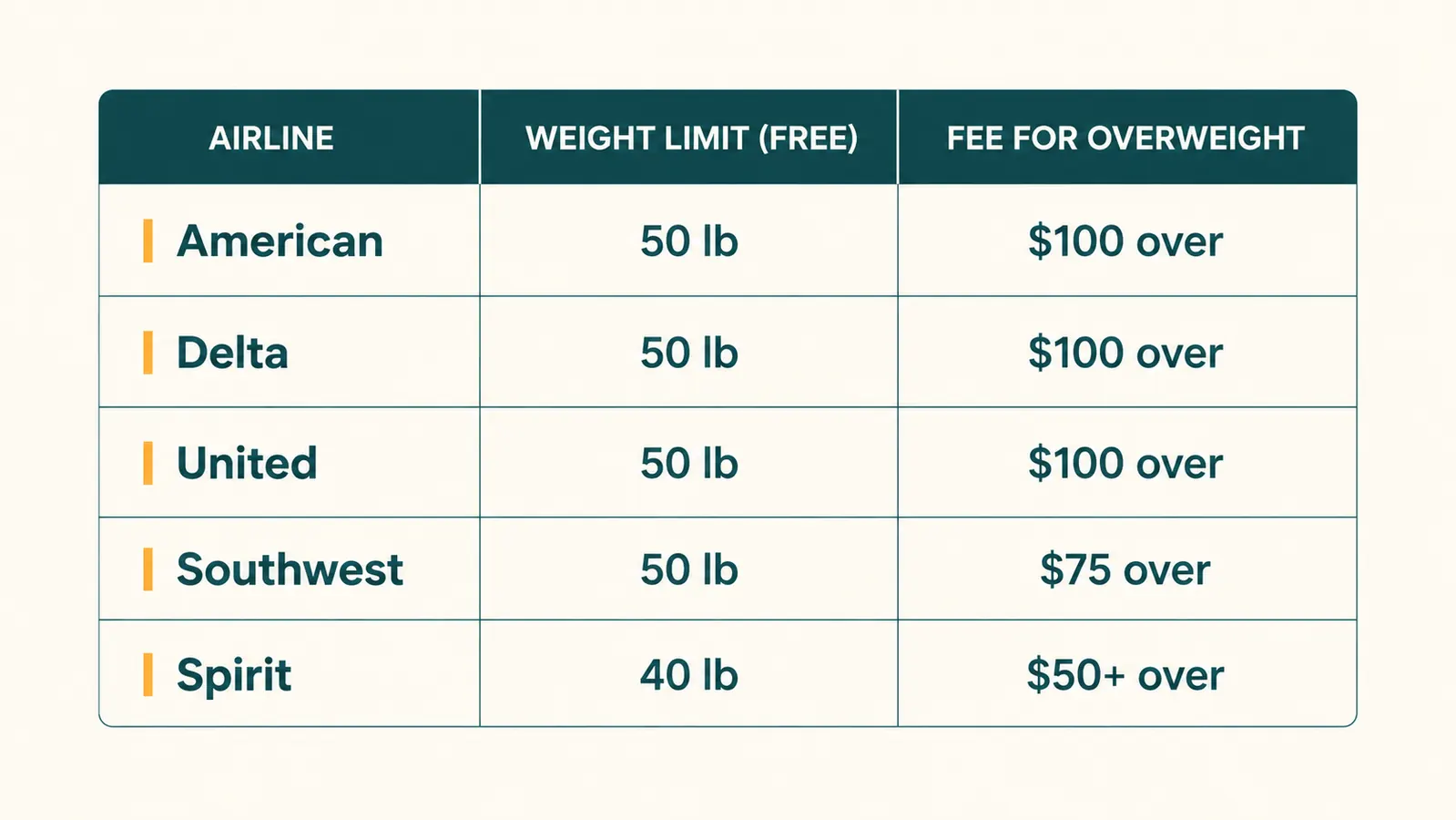
Most domestic flights in the United States allow checked bags up to 50 pounds for free. But "most" is not all of them, and international routes, budget carriers, and fare classes complicate the picture significantly. Spirit Airlines, for example, caps free checked bags at 40 pounds. If you pack to 50 pounds thinking you are safe and then fly Spirit, you are already in overweight territory before you reach the airport.
Before you start packing, look up the specific baggage policy for the airline and fare class you booked. Do not rely on memory from a previous trip. Policies change, and even within the same airline, a basic economy ticket on United has different allowances than a standard economy ticket. Write the limit on a sticky note or set it as a note on your phone. That number is your packing target, and everything else in this guide works backward from it.
A few limits worth knowing: American, Delta, and United all hold at 50 pounds for standard domestic checked bags, with overweight fees starting at $100 per bag. Southwest is the same 50-pound limit but charges $75 for the first overweight bag. Spirit charges $50 or more for bags over 40 pounds. On international routes, even 45-pound limits are common, and business class sometimes comes with higher caps. When in doubt, check the airline's baggage page directly, not a third-party aggregator.
Step 2: Weigh Your Empty Bag First and Subtract It From Your Budget
This step surprises a lot of travelers. A rolling suitcase is not weightless. A mid-size hardshell bag can weigh anywhere from 7 to 12 pounds on its own. Soft-sided expandable bags often come in between 5 and 9 pounds. If your airline limit is 50 pounds and your empty bag weighs 9 pounds, your actual packing budget is 41 pounds, not 50. Packing to the advertised limit without accounting for the bag itself is one of the most common ways people end up one or two pounds over at the counter.
Grab your digital luggage scale, hook it to the handle of your empty bag, and take a reading. Write that number down. Subtract it from your airline's weight limit. That remainder is your true packing budget. Now you are working with accurate numbers instead of optimistic guesses.
Your suitcase is not weightless. A mid-size hardshell bag can weigh 9 pounds on its own. Subtract that from your limit before you pack the first shirt.
Step 3: Pack Everything You Plan to Bring, Then Weigh the Full Bag
Pack your bag as you normally would. Do not try to estimate what things weigh in your head. Shoes are deceptively heavy. A full bottle of shampoo, even the travel size, adds up when you bring three or four of them. Cords, adapters, and books are the other hidden killers. Pack first, then check.
Once the bag is fully packed and zipped, clip the strap of your Etekcity luggage scale to the carry handle, hold the scale straight up with the bag hanging freely, and let the display settle. The Etekcity reads in both pounds and kilograms and locks the number on the display for several seconds so you do not have to stare at it while holding up 50 pounds. Read the number. Compare it to your packing budget from Step 2.
If you are under budget, you are done. If you are over, move to Step 4. Either way, you now know exactly where you stand. There is no guessing and no surprises waiting for you at the counter.
Step 4: Redistribute, Not Just Remove, When You Are Over the Limit
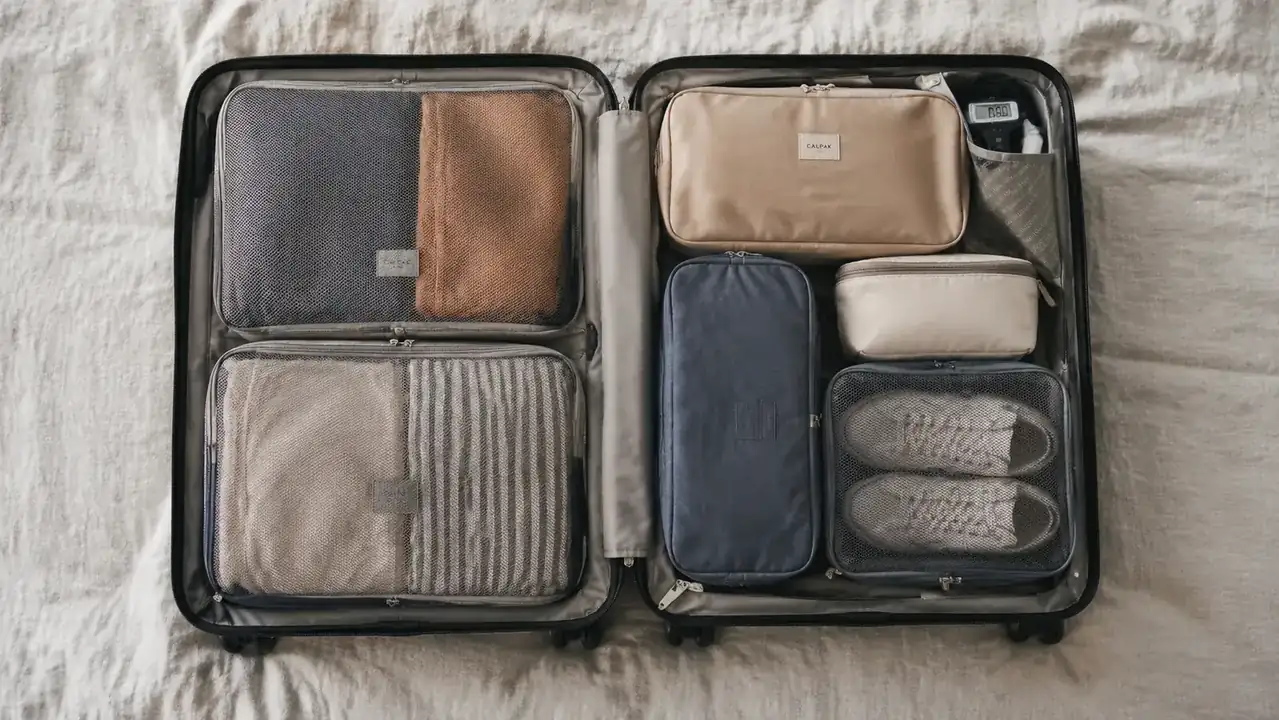
When the scale shows you are over your limit, the temptation is to start pulling things out and leaving them behind. Sometimes that is necessary, but often the smarter move is redistribution. Move heavier items into your carry-on bag or personal item. Shoes, electronics, and books travel just as well in a backpack under the seat as they do in a checked bag in the cargo hold.
If you are traveling with another person, check whether their bag is well under the limit and whether you can shift a few pounds into their checked bag. Airlines charge per bag, not per party, so as long as each individual bag meets the weight limit, it does not matter how the weight is distributed across the group. Two bags at 48 pounds each beats one bag at 54 pounds and another at 42 pounds.
After redistribution, weigh the bag again. Repeat the process until the number is where you need it. The whole sequence takes five minutes at home and saves you from spending that same time panicked on an airport floor. Weigh the carry-on too, while you are at it. Airlines are increasingly enforcing overhead bin weight limits, and some budget carriers charge for carry-ons that exceed 22 to 26 pounds.
Step 5: Weigh Again the Night Before Departure After Any Last-Minute Additions
This is the step most people skip, and it is the step that causes the most last-minute problems. You pack carefully, weigh your bag, confirm you are under the limit, and then the next two days happen. You add the power strip you almost forgot. You toss in a pair of sneakers because you decided you might want to walk a lot. You throw in the hardcover novel sitting on your nightstand. Each of those additions felt small in the moment. Together, they can push you over by three or four pounds.
Build the habit of a final weigh-in the night before you leave. It takes under a minute with the Etekcity and adds a real margin of confidence to your departure morning. If you are close to the limit, move something to the carry-on. If you are well under, enjoy the mental relief. Departure mornings are already busy enough without a packing crisis added to them.
One more habit worth developing: keep the scale in your bag during the trip. When you are packing to come home, especially if you have bought gifts or souvenirs, the return bag is often heavier than the departure bag. Weigh it before you head to the airport, not after you arrive at the counter.
What Else Helps
The five steps above will handle the overweight fee problem on their own. But a few complementary habits make the whole system run even more smoothly. Packing cubes help distribute weight evenly across the bag and make redistribution faster when you need to shift a few items. Instead of digging through a pile of loose clothes to find what to move, each cube is a self-contained unit you can pull out, weigh on its own, and reassign without unpacking everything.
Switching from full-size toiletries to TSA-approved travel bottles saves meaningful weight on every trip. A standard shampoo bottle weighs close to a pound. A filled silicone travel bottle of the same liquid weighs a fraction of that. Over the course of a week-long trip with three to four toiletry products, the difference can add up to two or three pounds, which is often the entire margin between under the limit and over it.
Finally, consider wearing your heaviest items on the travel day itself. Heavy boots, a thick jacket, and a hardcover book can all go on your body instead of in your bag. Airlines weigh checked luggage, not passengers. If wearing your winter coat through the airport means your bag stays under 50 pounds, that is a perfectly reasonable trade.
For a deeper look at whether the Etekcity scale is the right one for your kit, read our long-term review of the Etekcity luggage scale covering two years of use across dozens of trips. And if you are comparing it to the branded competition, our Etekcity vs. Samsonite scale comparison breaks down where the extra cost does and does not buy you anything.
The scale that has saved thousands of travelers from counter fees costs less than a single overweight charge.
The Etekcity digital luggage scale handles up to 110 pounds, displays in pounds and kilograms, locks the reading so you can see it while holding the bag, and comes with a built-in temperature sensor. It fits in a coat pocket and runs for years on two AAA batteries. At the current price, it pays for itself the first time it keeps you under the limit.
Amazon Check Today's Price on Amazon →