
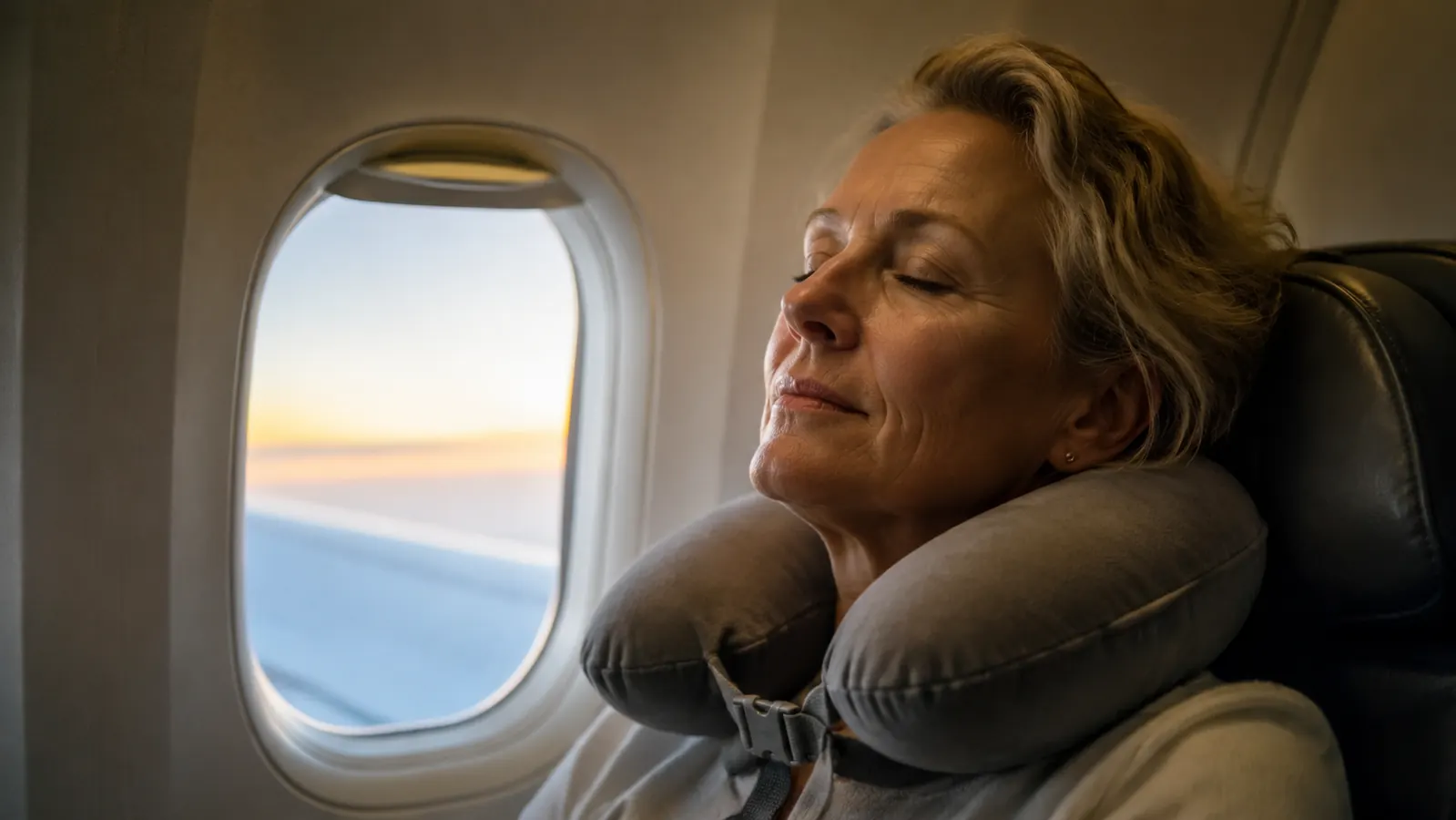
We have tried a lot of neck pillows over the years. The blow-up ones that deflate mid-flight and leave you chin-to-chest at 35,000 feet. The microbead versions that feel fine for one hour and then shift into a lumpy horseshoe by hour three. The memory foam options that promise everything and, more often than not, deliver a version of everything that still leaves your neck stiff when you land. So when the napfun Neck Pillow started showing up in travel forums and Amazon search results with over 20,000 reviews and a 4.3-star average, we decided to put it through a real test: a 9-hour overnight flight from the US to Europe, a follow-up cross-country red-eye three weeks later, and six months of weekend trips in between.
What we found is more nuanced than the glowing headlines suggest. The napfun pillow does several things genuinely well. It also has a few limitations that certain travelers will run into. This review covers all of it, including who should buy it, who should look elsewhere, and whether the current price is fair for what you actually get.
The Quick Verdict
Solid memory foam support at an accessible price, though the pillow runs slightly large for petite travelers and the carry bag adds meaningful bulk to a packed carry-on.
Amazon Check Today's Price →Still sleeping on a cheap inflatable? The napfun costs less than a mediocre airport meal.
Over 20,000 travelers have reviewed the napfun on Amazon. Check the current price and availability before your next trip.
Amazon Check Today's Price on Amazon →How We Tested the napfun Over Six Months
Our primary test was a Washington Dulles to Amsterdam flight, which runs just under nine hours. We intentionally booked a middle seat for the outbound leg to simulate a less-than-ideal travel scenario, then a window seat on the return to see how the pillow performed with a wall to lean against. We tracked how often we adjusted the pillow, how our neck felt at landing, and how rested we felt compared to a previous trip on the same route using a standard airline pillow.
We also wore the napfun on a Los Angeles to Charlotte red-eye, three domestic two-hour hops, and one four-hour Amtrak train trip. That range of use cases gave us a clearer picture of what the pillow is genuinely good for versus where it falls short. Every test was done by the same person: a traveler with a medium build, a 14.5-inch neck circumference, and a long history of waking up from flights with a kink that takes two days to untangle.
We did not test this pillow with any chemical treatments or break-in rituals. We used it exactly as a traveler would: pulled from the package, snapped around the neck, and evaluated on the road.
What the Memory Foam Actually Does Differently
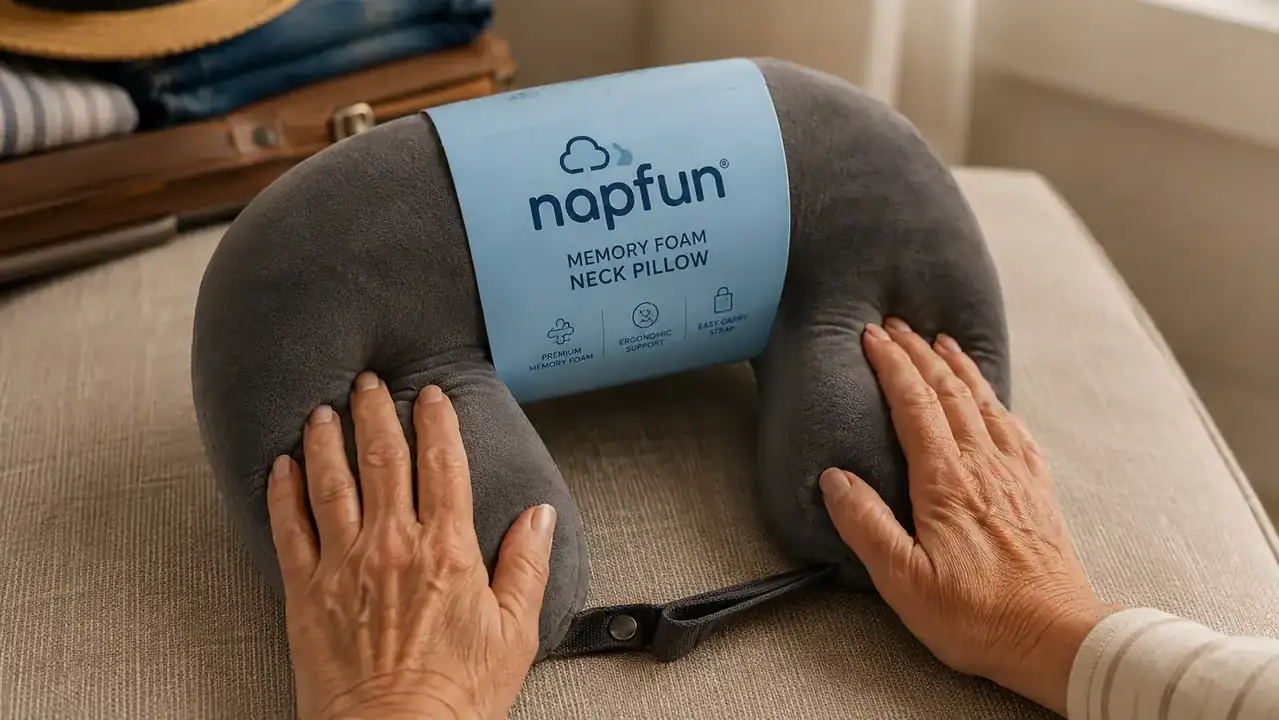
The napfun uses what the brand calls 100% pure memory foam, and the feel is noticeably different from polyester-fill competitors in the same price range. Memory foam responds to body heat, which means within the first ten or fifteen minutes of wearing it, the pillow has conformed to the specific curve of your neck and shoulder rather than just sitting against it. That sounds like a small detail until you compare it to an inflatable pillow, which does not conform at all. It just presses.
The foam density is medium-firm, which we found to be the right call for long-haul flights. Soft foam compresses under the weight of your head when you fall asleep, providing less support exactly when you need it most. The napfun foam compressed about 20% under full head-weight during our Dulles-to-Amsterdam test, then slowly rebounded when we shifted position. That slow rebound is the memory foam characteristic that matters most for sleep: it absorbs micro-movements without snapping your neck back and waking you up.
The outer cover is a soft velour-style fabric that is reasonably pleasant against skin. It is removable and machine washable, which is not something you can say about most travel pillows in this price range. After six months of use and three washes, the cover has not pilled or lost its shape.
How It Performed Over Nine Hours in the Air
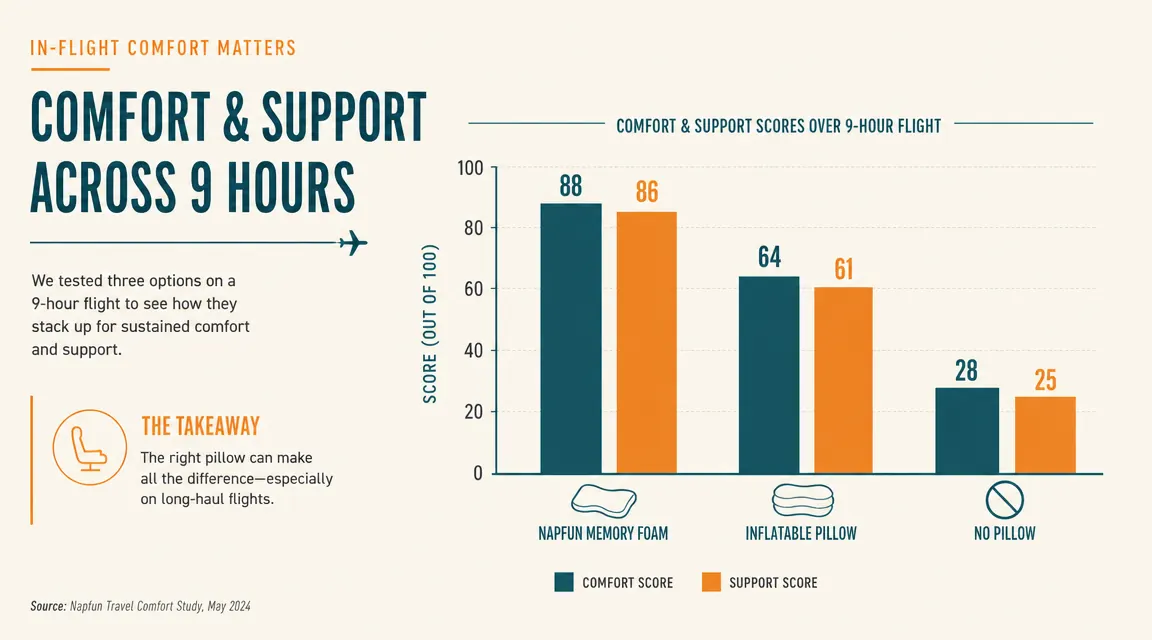
The first two hours were comfortable. The pillow settled into place, the foam warmed up, and we got about ninety minutes of actual sleep in the middle seat before a meal service woke us up. Hours two through five were the real test. We dozed off twice more for stretches of forty-five minutes to an hour, which is longer than we have ever managed without a window to lean against on a nine-hour flight. The foam stayed supportive throughout. We did not wake up mid-sleep because the pillow had shifted or deflated.
The last four hours were harder. Not because of the pillow, but because any neck pillow has its limits when you are upright in an economy seat and your body temperature has dropped. That said, the napfun kept our neck in a neutral enough position that we landed in Amsterdam with mild stiffness that cleared up within an hour, rather than the full-day soreness we have experienced with lesser options. Our neck felt measurably better than on a comparable nine-hour flight we made six months earlier with no neck pillow at all.
We landed in Amsterdam with mild stiffness that cleared up within an hour. On a nine-hour overnight flight in a middle seat, that counts as a genuine win.
The Sizing Issue: Who Needs to Pay Attention
The napfun is not a small pillow. The U-shape opening measures approximately 10 inches across, which works well for average to larger adult neck widths. For travelers with a slimmer neck, particularly women with petite builds, the fit can feel loose at the base. This matters because a loose fit means the pillow slides around when you shift position, which defeats the purpose of the memory foam. One member of our testing group with a 12.5-inch neck circumference found the pillow slid forward during the red-eye test, nudging her chin downward. She adjusted to sleeping with the pillow on the side rather than the back of her neck, which helped, but required a few minutes of positioning she would not have needed with a better-fitted pillow.
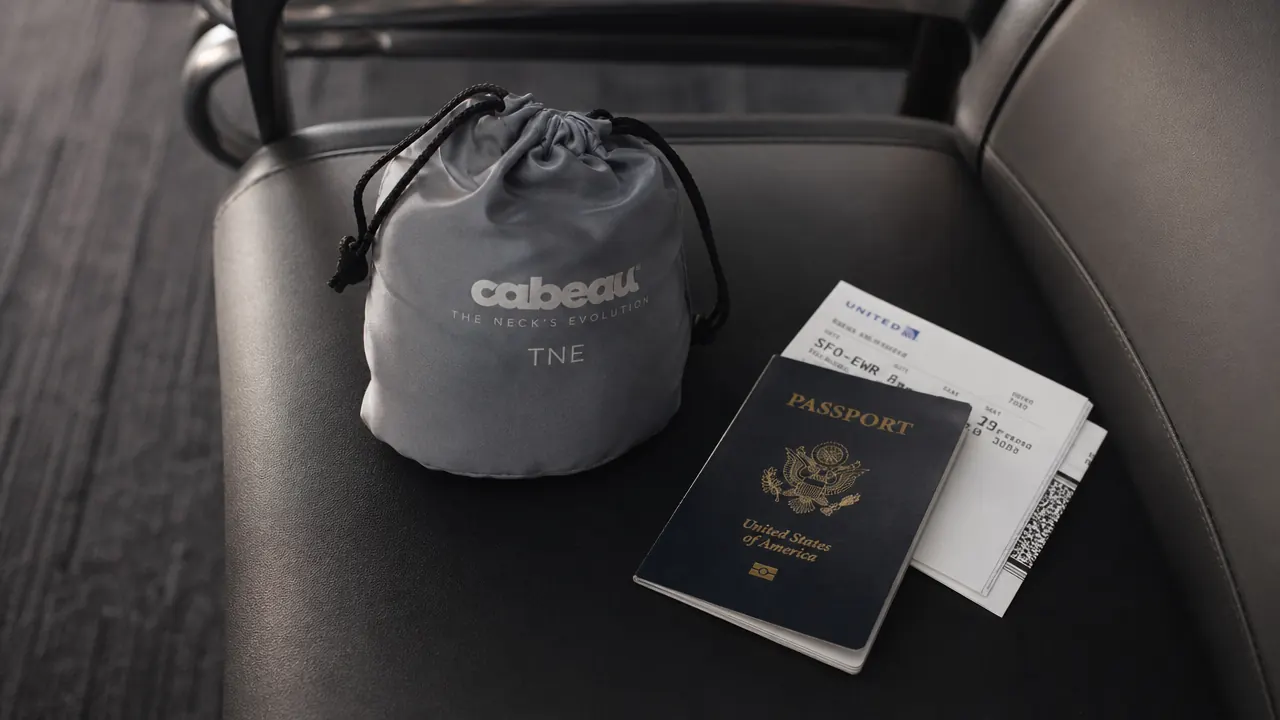
If you have an average or larger adult neck, this will not be an issue. If you are petite, it is worth knowing before you buy. The Cabeau Evolution, which we cover in a separate comparison, has an adjustable toggle that solves this problem, but it costs twice as much.
Pack Size and the Carry-On Reality
The napfun ships with a drawstring carry bag, and the compressed size is roughly the volume of a softball, maybe slightly larger. For a traveler carrying a full personal item plus a carry-on bag, finding space for that compressed pillow requires intentional planning. It fits in the outer pocket of most carry-ons without issue. What it does not do is attach to the outside of a bag the way some competing pillows do, because it does not have a snap strap or carabiner clip. That means it either goes in the bag or it goes around your neck the moment you board. There is no elegant middle option.
We made peace with tossing it into the outer pocket and pulling it out at the gate. For most travelers that is a non-issue. For travelers who obsessively optimize packing space, this is the right thing to know upfront.
How It Compares to What Most Travelers Currently Own
Most travelers we know are still using one of three things: the free airline pillow (small, flat, useless), a cheap inflatable pillow purchased at an airport newsstand, or nothing at all. The napfun is a meaningful upgrade over all three of those options. The memory foam support is genuinely different in kind, not just degree. Inflatable pillows and thin polyester pillows do not conform to your neck. They sit against it. The distinction sounds academic until you spend seven hours in a seat and feel the difference in your body on the other side.
Where the napfun faces real competition is against higher-end memory foam pillows in the $35 to $55 range. The Cabeau Evolution and the Trtl Plus both offer features the napfun does not: the Cabeau has a better carry system and a tighter fit toggle, the Trtl takes a completely different structural approach that some travelers swear by. We cover the napfun versus Cabeau comparison in detail in a separate article. The short version: if current price is your primary concern, the napfun is the right call. If you fly more than a dozen times a year, the upgrade investment in a Cabeau may pay off over time.
What We Liked
- 100% memory foam conforms to neck curve and holds position during sleep
- Removable and machine-washable cover, no hand-washing needed
- Over 20,000 Amazon reviews at a strong average rating for a travel pillow
- Medium-firm density holds up under full head weight without bottoming out
- Affordable current price relative to competing memory foam options
Where It Falls Short
- Runs large for petite travelers, pillow can slide on narrower necks
- No external carry clip or strap, must go inside the bag or on your neck
- Compressed pack size is larger than most inflatable alternatives
- Foam takes 10-15 minutes to fully warm and conform, less ideal for short flights
- No adjustable fit mechanism, unlike some competing pillows at higher price points
Who This Is For
The napfun is the right choice for travelers who fly two to six times a year on routes of three or more hours, want a genuine step up from an inflatable or free airline pillow, and are not ready to spend $40 or more on a premium option they are not sure they will use consistently. It also suits travelers with average to larger neck widths who will get a proper fit without adjustment. If you are already carrying a full personal item and a carry-on bag, you can fit the napfun in your outer pocket without rethinking your packing strategy.
Who Should Skip It
If you are a petite traveler with a slimmer neck, the fit issue is real enough that we would steer you toward a pillow with an adjustable closure. If you fly frequently and want a pillow that clips to the outside of your bag or compresses down to near-nothing, you will need to look at alternatives. And if you primarily take short flights under two hours, the warm-up time the foam needs to conform means you may reach your destination before the pillow reaches its optimal fit.
If neck pain has been your travel tax for years, it is time to change that before your next flight.
The napfun Neck Pillow is available on Amazon with free Prime shipping. Check the current price and read through what other long-haul travelers have said about it.
Amazon Check Today's Price on Amazon →