
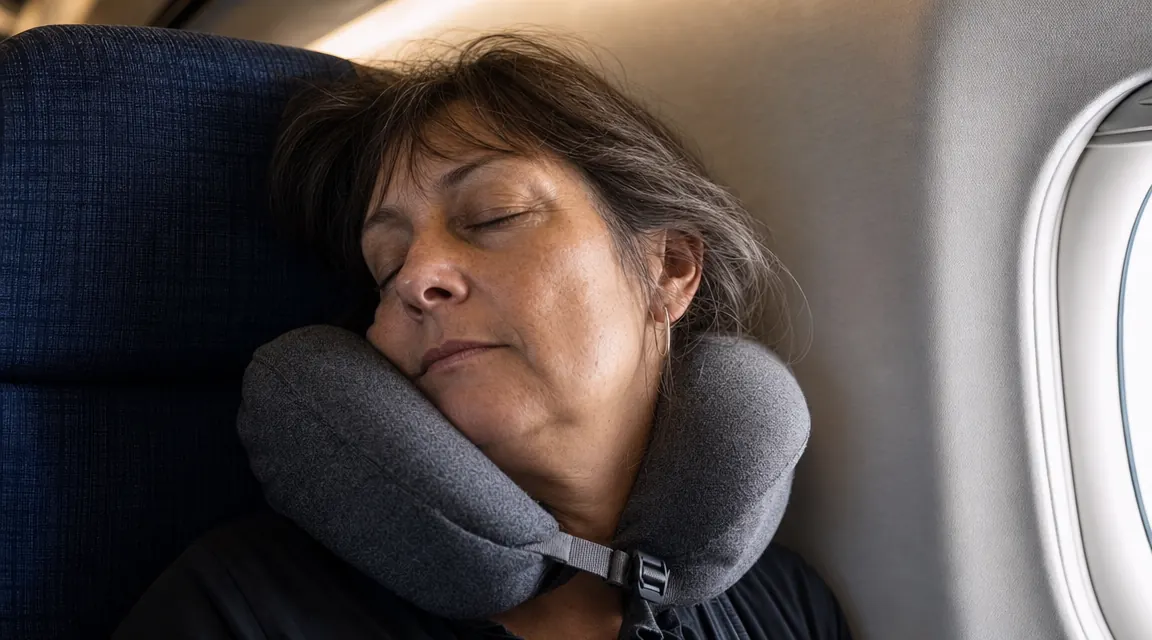
You have been there. You close your eyes somewhere over the Atlantic, you shift left, you shift right, you tuck your chin down. Three hours later the cabin lights come up and your neck announces its displeasure the moment you try to lift your head. It is one of the most predictable discomforts in travel, and most people simply accept it as the price of flying.
It does not have to be that way. After years of flying several times a year for family trips and school travel programs, I have worked out a consistent routine that gets me real, restorative sleep on planes, even in economy. The single biggest upgrade was switching to a memory foam neck pillow that actually supports the side and back of the neck rather than just wrapping loosely around it. The napfun Neck Pillow, built from 100% pure memory foam, is the one I reach for every time now. But the pillow is only part of it. Here is the full routine, step by step.
The pillow that stopped my post-flight neck stiffness for good
The napfun Neck Pillow uses 100% pure memory foam that molds to your neck shape rather than compressing flat. Over 20,000 travelers rate it 4.3 stars. If neck pain after flights is a regular problem for you, this is the tool worth having before your next trip.
Amazon Check Today's Price on Amazon →Step 1: Choose the Right Seat Before You Even Board
Seat selection shapes your sleep more than almost any other factor. A window seat is not just about the view. It gives you a solid surface to lean against and means no one needs to climb over you in the night. If you are on a red-eye or a long international flight, a window seat on your preferred sleeping side (most people favor leaning left or right based on habit) is worth paying a few dollars extra to secure at booking.
Avoid exit row seats for sleeping. The extra legroom is appealing, but most exit rows have fixed armrests that do not fold up, which eliminates the option of shifting sideways. Middle seats in standard rows are almost never good for sleep. If you cannot get a window, an aisle seat at least lets you lean out slightly and stretch a leg. The center of a three-seat row is the last resort.
When checking in online (usually 24 hours before departure on domestic flights), take an extra minute to scan the seat map for any empty rows near the back of the plane. If a row looks unoccupied, moving there after boarding can give you room to lie across multiple seats. This does not always work, but on less full flights it is one of the best upgrades available at no cost.
Step 2: Set Up Your Physical Environment in the First Ten Minutes
The ten minutes after boarding are when most passengers stow their bags and sit down to scroll their phones. That is the wrong order. Use those minutes to set up the environment so that when fatigue hits, you do not have to fumble around in a dark cabin.
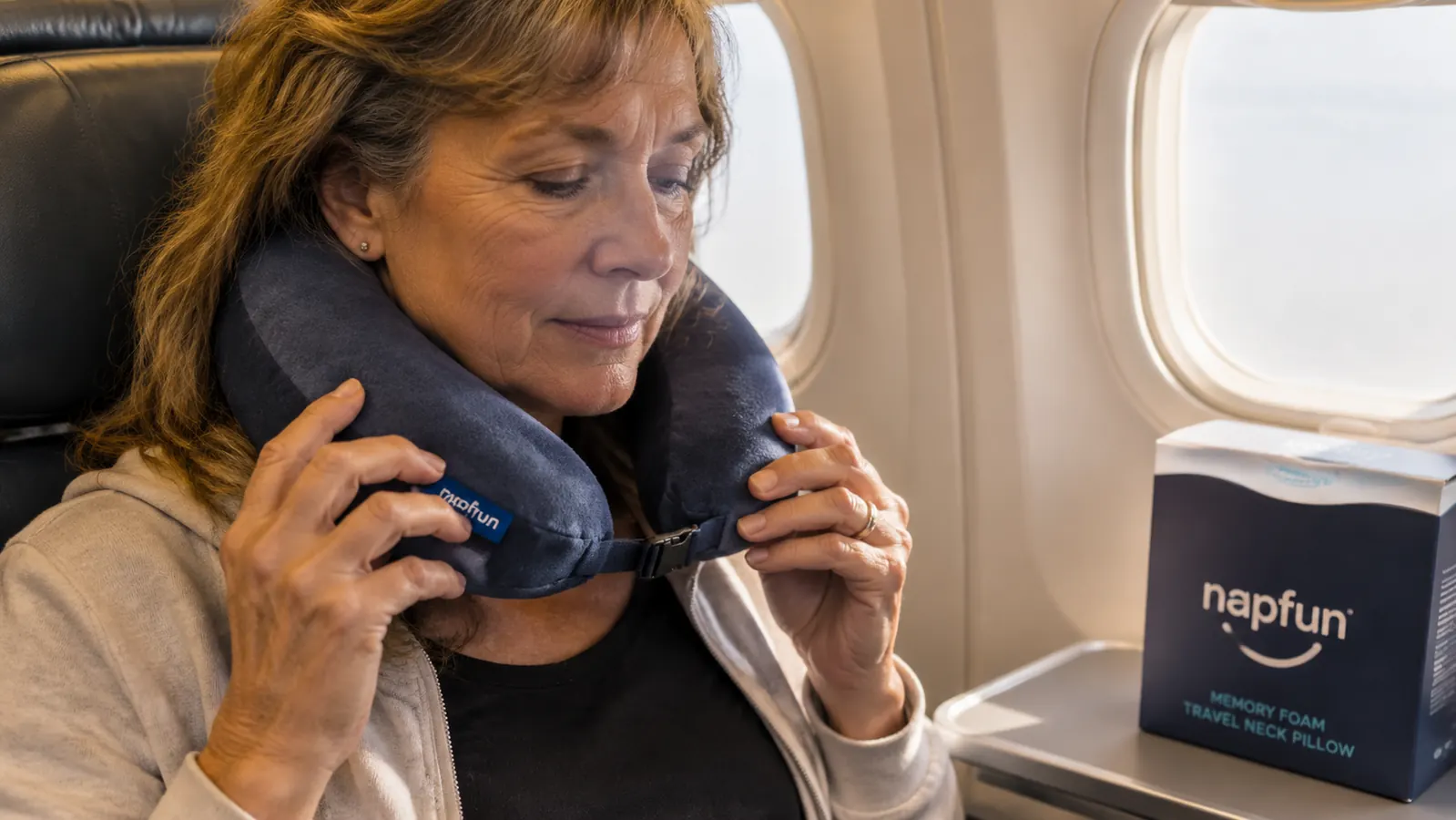
Get your neck pillow out and place it within immediate reach. Put your eye mask and earplugs or noise-canceling headphones in the seat pocket in front of you. If you use a light blanket or pashmina, unfold it now and drape it across your lap. Request your drink from the flight attendant during boarding if possible so you are not interrupting a sleep attempt later for a beverage. Turn your phone to airplane mode early, set a gentle alarm if you need to wake for a connection, and dim your screen brightness to minimum.
The goal is to remove every small friction point before they become mid-sleep interruptions. A pillow you have to dig out of an overhead bin at hour three is a pillow you will skip using altogether.
Step 3: Position the Memory Foam Neck Pillow Correctly
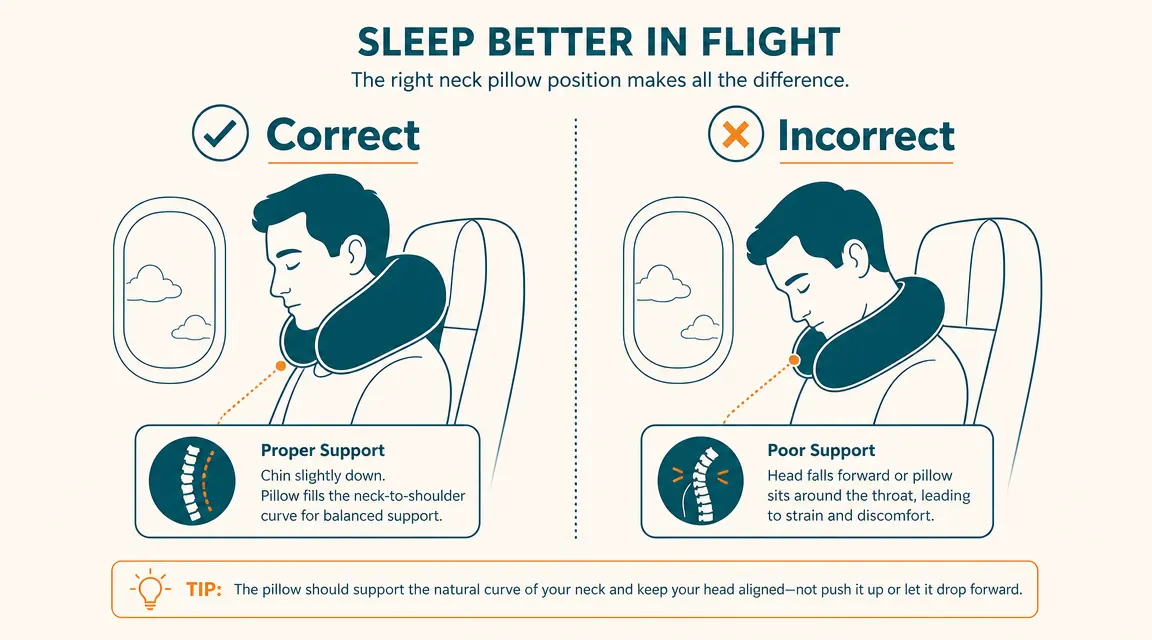
This is where most people go wrong, even when they have a good pillow. The common instinct is to wear the neck pillow centered at the back of the neck, with both ends resting symmetrically on your shoulders. That position works if you plan to sleep sitting completely upright, which almost no one actually does. In practice, heads tilt to one side, and when they do, that centered pillow offers nothing where the support is actually needed.
A better approach is to rotate the pillow slightly so the thicker, fuller side sits under the ear and jaw on the side you plan to lean toward. With the napfun pillow, the memory foam compresses slowly and holds that custom curve, which means it continues supporting your neck even as you shift slightly during sleep. The chin strap opening at the front of the pillow faces forward and keeps the pillow from riding up or slipping during turbulence.
If you are in a window seat, position the thick side toward the window and lean into it. If you prefer to sleep with your head slightly back, the pillow still cradles the base of the skull rather than leaving a gap. Adjust it while you are awake and comfortable so you know exactly where it should sit before the lights go down.

Step 4: Control Light and Sound Aggressively
Light and intermittent cabin noise are the two most reliable sleep disruptors on a plane, and both are almost entirely within your control. An eye mask is not a luxury item for elite travelers. It is a basic tool that costs next to nothing and blocks the reading lights, phone screens, and galley lighting that keep cabin environments inconsistently bright throughout a night flight.
For sound, the options run from simple foam earplugs (effective and very inexpensive) to over-ear noise-canceling headphones that cut engine drone significantly. Foam earplugs reduce ambient noise by around 30 decibels, which is enough to take the edge off a loud engine. Noise-canceling headphones playing light ambient sound or nothing at all can reduce the perception of cabin noise even further. The key is consistency: one or the other, reliably used, rather than hoping the cabin happens to be quiet.
Some travelers find that a white noise app playing through earbuds at low volume, combined with an eye mask, creates a genuinely good sleep environment even in economy. The combination costs less than most airport meals and makes a far more meaningful difference.
The window seat, the memory foam pillow rotated toward your lean side, and the eye mask are the three changes that together remove most of what makes plane sleep feel impossible.
Step 5: Time Your Sleep and Manage Hydration
Airplane cabins are pressurized to roughly 6,000 to 8,000 feet of altitude, which lowers the oxygen saturation in the air and accelerates dehydration. Mild dehydration makes it harder to stay asleep and often contributes to the groggy, headachy feeling after a long flight that people attribute entirely to the time change. Drinking water consistently throughout a flight, at minimum a cup every couple of hours, helps noticeably.
Caffeine and alcohol both make cabin dehydration worse and disrupt sleep quality even when they help you feel drowsy initially. A glass of wine might help you nod off, but the resulting sleep is lighter and more fragmented than it would be otherwise. If you are specifically trying to sleep through a long flight, skipping alcohol entirely on that flight tends to pay off in how you feel on arrival.
Timing also matters. On overnight transatlantic flights, try to stay awake for the first hour of boarding, eat if a meal is served, then put on your pillow, mask, and earplugs and commit to sleep. On shorter daytime flights, even a 90-minute nap is valuable. Set a gentle alarm so you do not sleep through a connection, and give yourself five to ten quiet minutes after landing before picking up your bags to let your neck and lower back ease out of position.
What Else Helps
Beyond the five steps above, a few smaller habits round out the routine. Wearing loose, layered clothing makes it easier to stay comfortable across the temperature swings common in long-haul cabins. A light compression sock reduces leg swelling on flights over four hours, which in turn makes it easier to stay still and sleep rather than feeling the urge to shift and stretch constantly. A small travel blanket or a lightweight pashmina pulled over your shoulders adds warmth without bulk.
If neck stiffness tends to linger for a day or two after long flights, a few minutes of gentle neck rolls and shoulder circles at the gate before deplaning can help. The goal is to move the muscles back through their range of motion while they are still warm from travel, before you stiffen up further sitting in an airport shuttle or car ride home.
For travelers who fly regularly, the napfun Neck Pillow is worth keeping packed and ready rather than leaving at home between trips. It compresses into a small carry bag that clips onto a luggage handle, so it does not take up meaningful space in a carry-on. You can read our full long-term review at the napfun Neck Pillow long-haul review, and if you are comparing it against higher-priced options, the napfun vs Cabeau Evolution comparison breaks down exactly where each one earns its place.
Ready to stop arriving at your destination stiff and exhausted?
The napfun Neck Pillow gives you the memory foam support that actually holds through a full flight, in a size that packs away without eating your carry-on space. More than 20,000 travelers have made it part of their routine. Check today's price and see if it ships in time for your next trip.
Amazon Check Today's Price on Amazon →